
1988 Yamaha press information
TDR Features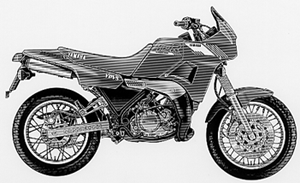
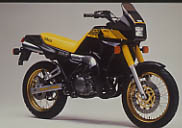
And as for looks, a tank-mounted head fairing rounds out the TDR's unique styling theme. The 250cc class will never again be the same.
TECHNICAL HIGHLIGHTS
* Combination of CDI and digital timing advance system
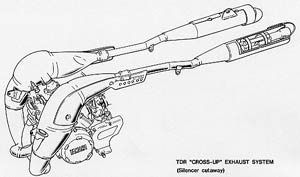
* High-efficiency "cross-up" exhaust system
* Air-assisted front fork and rising-rate Monocross rear suspension system
* Front and rear disc brakes and dual-purpose tyres
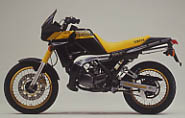
* Unique styling and aerodynamic head fairing
sports and delivered 50 HP.
Engine
While essentially a TZR 25O unit, a variety of modifications have been made to better suit engine power delivery with intended use. Lowered first gear ratio (45/14 against the TZR 25O's 4 1/14) dramatically improves acceleration while increasing off-road traction. Power is transmitted to the rear wheel via a sealed, continuous-link chain for high durability and low maintenance.
The newly designed "cross-up" exhaust System, featuring "satellite-chrome" plated silencers, is tuned for low- and mid-range power. It ensures plenty of ground clearance and free rider movement. The 28 mm flat-slide carburettors have been re-jetted to match the different breathing requirements of the new pipe and air box.
The TDR is the world's first motorcycle to combine a CD ignition with a digital timing advance system. Controlled by a 4-bit microprocessor, it ensures perfect ignition timing at all rpm. The microcomputer also serves as a control unit for the YPVS and side-stand switch, contributing to savings in weight and space.
Aside from the above modifications and new silver paint, the TDR engine shares all the virtues of the TZR unit: efficient case-reed induction with fibre reeds and 28 mm flat-slide carbs; YPVS; sealed liquid-cooling system with lightweight radiator and coolant passageways around the exhaust ports; and Autolube oil injection with YPVS-controlled pump. The TDR also shares the TZR's orthogonal engine mounting system which reduces vibration. This high-powered stormer will soon be the "quickest bike in town." Maximum speed will exceed 100 mph - quite impressive, when one considers the upright riding position. (A 240 cc version will be sold in France to meet local requirements.)
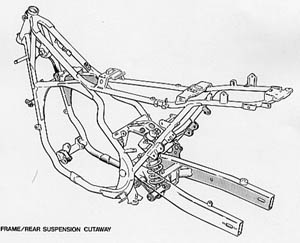
headstock gave agile handling on the road and
ensured some off-road capability too.
Frame
Fabricated of high-tensile steel tubes, the double-cradle frame features high strength and low weight. Both the top and down tubes are narrowly spaced near the steering head to permit a wide steering angle, and extensive gusseting are used at this point for increased rigidity. Tapered roller bearings are used at the steering head for increased durability and reduced flexing. Cast-aluminium passenger footrest brackets are mounted on the rear sub-frame.
Suspension
An air-assisted, centre-axle front fork uses stiff 38 mm stanchions. A steep 27-degree castor angle and 114 mm of trail contribute to the TDR's short wheelbase and quick-handling characteristics. Front wheel travel is 160 mm. The fork is adjustable for air pressure and spring pre-load, and is fitted with rubber gaiters to protect the tubes from debris.
The rising-rate Monocross rear Suspension system features a De Carbon-type gas/oil shock absorber with separate reservoir operated by a box-section swinging arm of high-tensile steel. Rear wheel travel is 150 mm.
This suspension System is designed to provide an idealized compromise between on- and off-road riding - with a slight street bias. Brakes
The TDR uses front and rear disc brakes. The front disc is a 320 mm floating unit operated by a 4-pot, opposed-piston calliper, while a 210 mm disc with opposed-piston calliper is used at the rear (the discs are same as the TZR's).
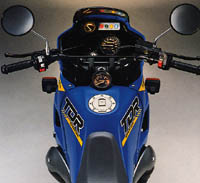
mounted on top of the fuel tank
Fairing, Instrumentation, Fuel Tank and Seat
Another unique feature of the TDR is its stylish tank-mounted head fairing. Tank mounting frees the front end of excessive weight for light handling while ensuring free rider movement. A square, 60/55W halogen headlamp is used, and the turn indicators are mounted on flexible rubber stalks. Inside the fairing are located the water temperature gauge and indicator lamps, while the speedometer is positioned right in front of the steering head. The tachometer is situated at the front of the fuel tank. This design minimizes inertia moment at the front end. The 14-litre fuel tank has an aircraft-style cap and automatic, negative pressure-activated fuel tap. The seat features thick padding and roominess, with the oil tank, air box, tool and glove boxes underneath. The ignition key is used to unlock the seat. A pair of grab-rails are fitted on the rear cowl. Wheels and Tyres
The 18-inch front and 17-inch rear spoked wheels have light aluminium rims and will be fitted with either Metzeler Enduro 3 Sahara or Bridgestone Trail Wing tyres for good traction on both tarmac and dirt. The low front fender directs cooling air to the radiator.
The Yamaha TDR - adding a new dimension to the already exciting field of sport riding.
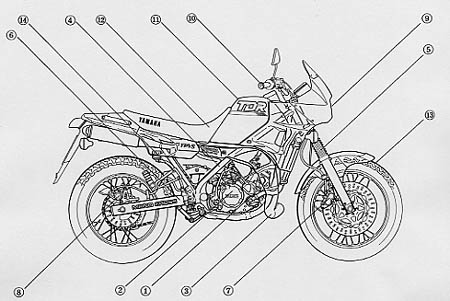
1988 press kit Feature Map
TDR FEATURES
1) 2-stroke, 249 cc, liquid-cooled,
crankcase reed-valve, parallel twin-cylinder engine.
* Yamaha Power
Valve System (YPVS)
* Mikuni TM28SS flat-slide carburettors and fibre
reeds
* Low secondary reduction for increased traction
* Sealed,
continuous-link drive chain
* Sealed cooling system with alloy radiator
& coolant passage around exhaust ports
* Autolube oil injection
System with microcomputer-controlled oil pump
* Yamaha's "orthogonal"
engine mounting for reduced vibration
2) Capacitor discharge ignition
with microcomputer-controlled, digital timing advance System.
3)
"Cross-up" exhaust system featuring satellite -chromed silencers.
4)
Light' strong double-cradle frame fabricated of high-tensile steel tubes.
Tapered roller bearings are used at the steering head.
5) Sturdy 38 mm
front fork is adjustable for air pressure and spring pre-load. Provides
160 mm of wheel travel.
6) Rising-rate Monocross rear suspension uses a
De Carbon-type gas/oil damper and a box-section, high-tensile steel
swinging arm. Rear wheel travel is 150 mm.
7) A drilled, 320 mm front
disc stopped by a 4-pot, opposed-piston calliper. The rotor is floating for
precise control.
8) The rear brake consists of a drilled, 210 mm disc
and an opposed-piston calliper.
9) Stylish head fairing is mounted to
the petrol tank for nimble handling. lt houses a powerful 60/55W halogen
headlamp.
10) Simplified instrument panel features tank-- mounted
tachometer for easy reading.
11) The tank holds 14 litres of petrol and
uses an aircraft-style filler cap and a negative pressure activated
tap.
12) Roomy' deeply padded seat is 820 mm from the ground. Separate
passenger grab bars are fitted to the tail cowl. The oil tank, air filter,
tool and glove boxes are situated beneath the seat.
13) 18" front and
17" rear spoked wheels have aluminium rims, and are shod with Metzeler or
Bridgestone high-grip tyres. Low front fender helps cooling
efficiency.
14) Lightweight cast-aluminium pillion footrest
brackets.
SPECIFICATION TDR 250
ENGINE*[ ] = French model
Type 2-stroke, liquid-cooled, crankcase reed-valve, parallel
twin-cylinder
Displacement 249 cc [239 cc]
Bore and stroke 56.4 x 50.0 mm [55.2 x 50.0 mm]
Compression ratio 5.9:1 [5.7:11
Maximum power (DIN) 50.3 PS (37.1 kW) @l0,000 rpm
[44.3 Ps (32.6 kW) @10,000 rpm]
Maximum torque (DIN) 3.7 kg-m (36.2 Nm) @8,500 rpm
[3.5 kg-m (34.6 Nm) @9,500 rpm]
Carburetion Mikuni TM28SS x 2
Ignition Capacitor discharge, with digital timing advance
Starting Kick
Lubrication Autolube oil injection
Oil tank capacity 1 .4 litresTransmission
Type 6-speed, constant-mesh
Primary reduction ratio .... 5 6/22 (2.545)
Secondary reduction ratio . . 45/14 (3.214)
Gear ratio, 1st 36/14 (2.571)
Gearratio,2nd 28/16 (1.750)
Gearratio,3rd 25/19 (1.316)
Gearratio,4th 26/24(1.083)
Gear ratio, 5th 25/26 (0.962)
Gear ratio, 6th 23/27 (0.852)
Clutch type Wet, multi-plate
Final drive ChainCHASSIS
Overall length 2,145 mm
Overall width 785 mm
Overall height 1,2 15 mm
Wheelbase 1,385 mm
Minimum ground clearance 230 mm
/span>CHASSIS
Overall length 2,145 mm
Overall width 785 mm
Overall height 1,2 15 mm
Wheelbase 1,385 mm
Minimum ground clearance 230 mm
Seat height 820 mm
Dry weight 137 kg
Fuel tank capacity 14.0 litresSuspension
Front Telescopic fork (160 mm travel)
Rear Rising-rate Monocross (150 mm travel)Brakes
Front Hydraulic disc, with 320 mm floating disc and 4-pot opposed-piston calliper
Rear Hydraulic disc, with 210 mm disc and opposed-piston calliperTyres
Front 100/90-18H
Rear 120/80-17H